Insights
Amazon Nova Act: The Guide for 2026
Amazon Nova Act achieves 90% reliability in browser automation at 1/100th the cost. Learn how AWS's agentic platform eliminates API gaps and maintenance debt.
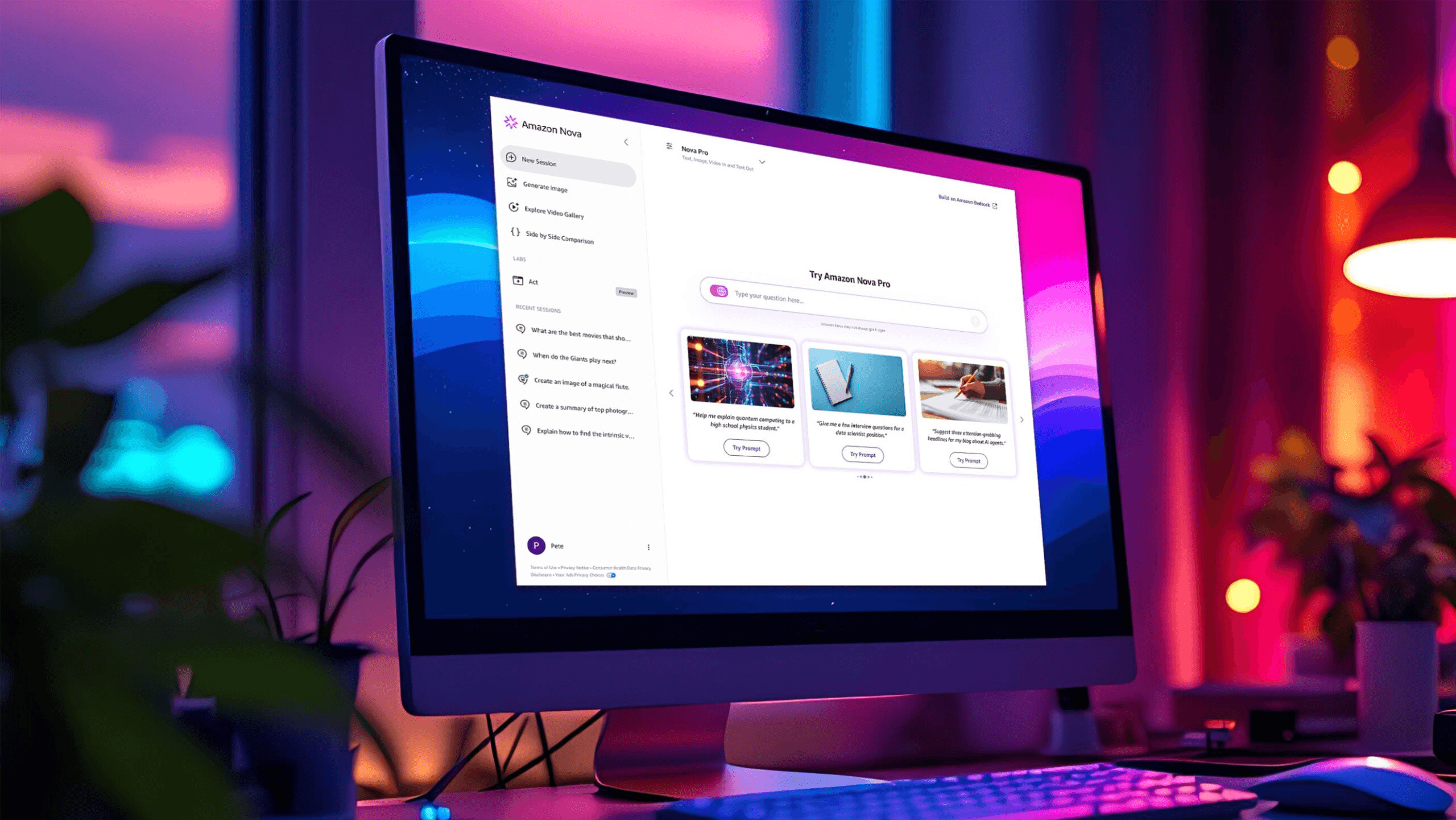
TL;DR: Amazon Nova Act is AWS's breakthrough agentic automation platform that achieves 90% reliability in browser-based workflows—solving the decades-old problem of automating software without APIs. It compresses manual tasks from hours to seconds at 1/100th the cost.
The Automation Gap Enterprise Software Never Solved
For decades, enterprise automation has been stuck between two broken options: API integrations that only work when vendors provide them, and UI automation tools that break every time a developer changes a button ID.
The result? Millions of knowledge workers still manually log into portals, copy data between systems, download invoices, and click through multi-step workflows—not because the work is complex, but because the software lacks APIs and traditional automation is too fragile to maintain.
At AWS re:Invent in December 2025, Amazon introduced Nova Act—the first large-scale agentic platform capable of reliably navigating web interfaces with human-like understanding. For engineering teams drowning in flaky Selenium tests or expensive RPA licenses, this represents a fundamental shift in how software gets automated.
From Chatbots to Digital Workers
The past few years gave us Generative AI: models that write, summarize, and explain. Useful, but fundamentally advisory. They produced recommendations—humans still clicked the buttons.
Nova Act is part of the next wave: Agentic AI. Instead of telling you what to do, agents actually do the work. They log into portals, fill forms, navigate workflows, and verify outcomes—autonomously.
As AWS CEO Matt Garman stated at re:Invent, "the next 80-90% of enterprise AI value will come from agents." Nova Act is AWS's infrastructure play for that future.
Why Traditional Automation Fails
Selenium and Playwright work great for deterministic tests but shatter when CSS selectors change. A script looking for #submit-button fails catastrophically if that ID gets renamed—creating endless "maintenance debt" where engineers spend more time fixing scripts than they saved automating them.
Legacy RPA platforms like UiPath require expensive per-bot licensing, heavy infrastructure, and rules-based logic that can't adapt to dynamic UIs. Setup takes weeks; changes take days.
Early "computer use" agents cobbled together from generic LLMs and vision models are too slow (4+ minutes per workflow), prone to hallucinations, and unreliable—achieving only 50-60% success rates on complex benchmarks.
Nova Act solves this through vertical integration: a specialized model, managed runtime, and developer SDK designed specifically for browser automation.
What Nova Act Actually Is: Three Integrated Layers
1. Nova 2 Lite – The Action-Optimized Brain
Unlike general-purpose LLMs, Nova 2 Lite is engineered for speed, visual understanding, and web task execution. It underwent reinforcement learning training in simulated browser environments, learning to recognize UI patterns semantically rather than relying on brittle selectors.
This means it understands that a magnifying glass icon means search, a grayed-out button is disabled, and a modal must be closed before proceeding—just like a human would.
2. AgentCore Browser – Managed, Scalable Runtime
AgentCore is AWS's fully managed headless browser infrastructure. It provides VM-level isolation, auto-scales to thousands of concurrent agents, and delivers deep observability with session replay and audit logs.
For DevOps teams, this eliminates the nightmare of zombie browser processes, memory leaks, and grid maintenance. It's consumption-based infrastructure that scales elastically.
3. Nova Act SDK – Hybrid Code + Natural Language
Developers use the Python SDK to blend natural language instructions with traditional code:
agent.act(f"Download all invoices from {start_date} to {end_date}")

if agent.current_url != expected_url:
    raise Exception("Navigation failed")
This hybrid approach uses AI for flexible UI navigation and code for logic, validation, and control flow. When the model hits edge cases, developers can drop into raw Playwright commands—ensuring one problematic widget doesn't block the entire workflow.
The 90% Reliability Breakthrough
Nova Act achieves approximately 90% reliability on complex web workflows—critical because reliability compounds mathematically. If an agent is 98% accurate per step and your workflow has 30 steps, overall reliability drops to just 54%.
The breakthrough comes from semantic interaction: rather than clicking #submit-btn-blue, Nova Act understands the intent ("Complete purchase") and uses visual and accessibility cues to locate elements—even when IDs change, layouts shift, or designs are refactored.
According to AWS benchmarks, Nova Act scored 94% on ScreenSpot Web Text, outperforming Anthropic's Claude 3.7 Sonnet (90%) and OpenAI's Operator (88%).
Real-World Use Cases
Self-Healing QA Automation
Convert manual test plans into automated suites that adapt to UI changes automatically. When a developer renames a button, Nova Act finds it by semantic intent—no script updates required. Tyler Technologies reported saving "hundreds of hours" using this approach.
Legacy System Wrappers ("Agentic APIs")
Wrap web-only systems behind clean APIs. Agents log in, navigate to the right module, extract data, and return structured JSON—modernizing brownfield applications without expensive rewrites or vendor lock-in.
DevOps and Incident Response
Deploy agents as 24/7 on-call assistants that query logs, correlate incidents with recent deployments, identify root causes, and propose fixes—compressing 30-60 minute investigations into seconds.
Back-Office Digital Workers
Automate "swivel-chair" work: invoice downloads across 50 carrier portals, claims intake and triage, supplier onboarding, benefits enrollment. If a human currently does it in a browser, Nova Act is a candidate.
The 100x Economics
Human QA Tester: $50/hour, ~10 tests/hour = $5.00 per test Nova Act Agent: ~$0.01/minute in tokens, ~1 test/minute = $0.05 per test
This 100x cost reduction doesn't just save money—it enables previously impossible behaviors:
- Continuous testing on every commit instead of once per release
- Bursty workloads like processing 10,000 claims overnight
- Expanded test coverage beyond just happy paths
- High-frequency monitoring (competitor prices checked hourly) The hidden gain? Eliminated maintenance debt. Nova Act agents self-heal when UIs change, freeing engineers from the endless task of fixing brittle scripts.
How LogicFox Delivers Nova Act in Production
LogicFox specializes in Agentic Automation Architecture—designing, deploying, and operating fleets of Nova Act-powered digital workers.
Rapid Prototyping
In your first workshop, we watch a real workflow and build a working prototype agent using natural language. We demonstrate "hours to seconds" in a single session—proving value immediately, not in quarters.
Reusable Agent Library
We maintain pre-built modules for common tasks: portal login, table extraction, document upload, CAPTCHA solving, date picker navigation. These blocks chain together to create complex workflows in days instead of weeks.
Managed Digital Workforce
We don't just hand over scripts. We provide:
- Centralized monitoring dashboard with success metrics and time saved
- Human-in-the-loop escalation for the 10% of edge cases
- Ongoing optimization as your UIs and processes evolve Think of it as subscribing to a digital workforce—a managed service, not a one-time project.
The Bottom Line
Nova Act closes the API gap that has forced enterprises to choose between expensive rewrites and manual labor. It eliminates brittle selector-driven automation and its crushing maintenance debt. It compresses operational work from hours to seconds—then parallelizes it across thousands of agents.
This isn't an incremental improvement. It's a fundamental restructuring of how enterprise software gets built, tested, and operated.
For QA teams, it means continuous testing becomes economically viable. For DevOps, incident response shifts from investigation to approval. For enterprises, legacy systems without APIs can finally be integrated without rewrites.
The barriers that prevented software from interacting with the visual web—fragility, complexity, and cost—have been dismantled.
Ready to see Nova Act automate your workflows?
LogicFox can design and ship your first production-ready agent in days, not quarters. We'll build a working prototype in your first session.
👉 Book a strategy session with LogicFox
The era of building chatbots that talk is over. The era of building agents that work has begun.